

Sea mammal researchers from Utrecht University’s Veterinary School have had a busy few months due to five sea mammal strandings involving four different species of sea mammal.
The first was a young female common bottlenose dolphin that stranded in the Oosterschelde; this species is rarely seen today in Dutch waters. It is believed that the animal was alive when it became stranded although the reason for the stranding has not yet been determined. Post-mortem was carried out shortly after the death and investigation of tissues under the microscope will be performed by university pathologists. Additionally, the contents of the gastrointestinal tract will be studied by researchers from Imares (Institute for research into strategic and applied marine ecology).
| The second stranding involved a beaked whale, a deep-diving, ocean-going species that is seldom seen in Dutch waters and which is therefore not suited to the shallow North Sea. Post-mortem of this young female animal, 3.66m in length and weighing about 500kg was performed at the site of the stranding on the Dutch Wadden Sea Island of Schiermonnikoog. The cause of death was suffocation due to sand in the lungs and it is hoped that study of tissues under the microscope may shed light on why this occurred. The contents of the gastrointestinal tract will be studied by researchers from Imares. The skeleton of this unique animal will be prepared and displayed at the Natural History museum in Leiden and later exhibited at Ecomare on Texel. | 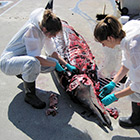 Photo: Aline Visser Photo: Aline Visser |
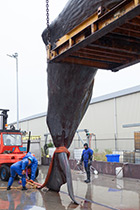
| The third stranding, of a live male sperm whale, occurred on the 28th July on the Dutch Wadden Sea island of Terschelling. It is not known how long the animal was stranded before it died. It was subsequently transported to Harlingen harbour where post-mortem was performed by a team from the University of Utrecht and staff from BDS Harlingen and Naturalis. A striking finding in this case was an abnormality of the lower jaw; a large portion of the bone was missing and surrounded by old scar tissue. Whilst this could potentially have impaired the hunting ability of this animal, it is unlikely as the sperm whale had a good nutritional status. Analysis of stomach contents revealed the remains of hearing apparatus belonging to same species of fish and several bits of plastic. Unfortunately, the investigation of tissues from this animal under the microscope is not expected to add any significant findings due to the advanced state of decomposition caused by the extended (>24h, due to transport complications) period between death and the post-mortem. |
 |
The fourth incident occurred two days later when a young fin whale was found on the bow of a ship as it entered Rotterdam harbour. It is believed that this fin whale was struck by the boat in the Bay of Biscay where large numbers of these whales are found. It is likely that the whale had died 3-5 days prior to post-mortem being perfomed. Limited funding prevented extensive sampling (only lung, hart, liver, intestines, stomach, lymph node, muscle and blubber). The stomach contained a large amount of red material (interpreted as krill) indicating that the animal had recently eaten was therefore fit enough to locate foodstuffs and feed. The other significant finding was the presence of subcutaneous bruising believed to be the site of impact with the ship, although interpretation of subtle lesions is impossible due to the advanced state of decomposition of the tissues.
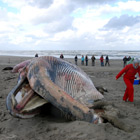
| The fifth stranding involved a second fin whale, in this case a 17m-long male which stranded on the beach of ‘s Gravenzande on the 17th of September. This animal had also died following collision with a ship. The cadaver was severely decomposed and sampling was therefore limited. An important finding is the absence of stomach contents. The skeleton of animal will be prepared and displayed at the Natural History museum in Leiden. |
 |