

From March 2024 to August 2025, the DWHC, together with the WBVR, commissioned by the Ministry of Agriculture, Nature and Food Quality (LVVN), tested a total of 50 foxes from the province of Friesland for avian influenza (bird flu). This research is being conducted to develop an effective surveillance program for highly pathogenic avian influenza (HPAI) in mammals.
Avian influenza primarily affects (water)fowl, but mammals can also become infected. In Europe, the virus is most often found in mammals like carnivores and scavengers. Wild carnivores and scavengers come into contact with the virus when eating the carcasses of infected birds, for example.
For this research, foxes killed for wildlife management have been sampled by the DWHC and analysed by the WBVR. The collected foxes were tested for the presence of the HPAI virus and/or HPAI-specific antibodies.
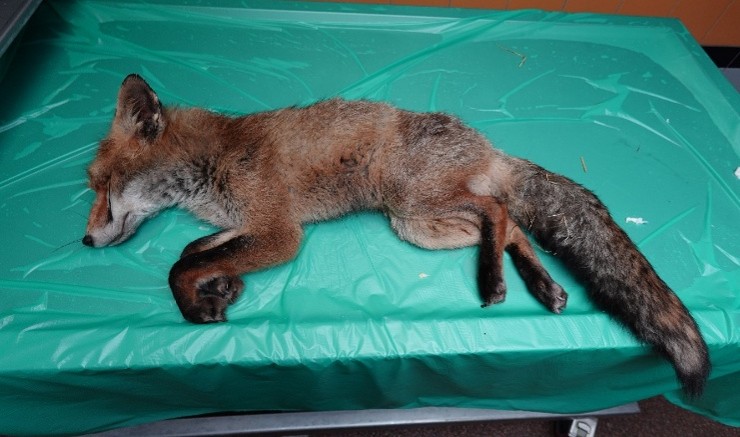
Two of the 50 foxes examined tested positive for the avian influenza virus. In one of these samples, further genetic analysis was possible. This revealed that it was a specific variant of the avian influenza virus, also circulating in wild fauna from the same region and time period (namely H5N1 clade 2.3.4.4b Genotype EA-2024-DI.2). The genetic analysis also identified potential zoonotic mutations. These specific mutations are considered important indicators of avian influenza virus adaptation to mammals.
Of 47 foxes the presence of antibodies for HPAI in their blood could be tested, 22 of which tested positive. This means that these foxes had encountered avian influenza at some point in their lives.
This research demonstrates that foxes are a good indicator species for monitoring avian influenza in mammals in an area. Testing foxes killed for wildlife management can contribute to the surveillance of avian influenza infections in mammals.
View the full report here (in Dutch).