
As part of the Strong1Health project, wild mammals are being tested for bird flu. Between November 2025 and June 2026, the aim is to test as many dead carnivores and scavenging mammals as possible for infection with the bird flu virus and antibodies against the bird flu virus. The goal is to optimize the surveillance of highly pathogenic avian influenza in wild mammals. The animal species eligible for testing are:
Highly pathogenic avian influenza primarily affects (water)fowl, but can also be fatal to humans and other mammals. Infection of mammals carries the risk of virus adaptation into a virus more susceptible to transmission in mammals. To detect this early and take preventive measures, surveillance of highly pathogenic avian influenza in wild mammals is crucial. To achieve this, we need to understand what’s happening in nature.
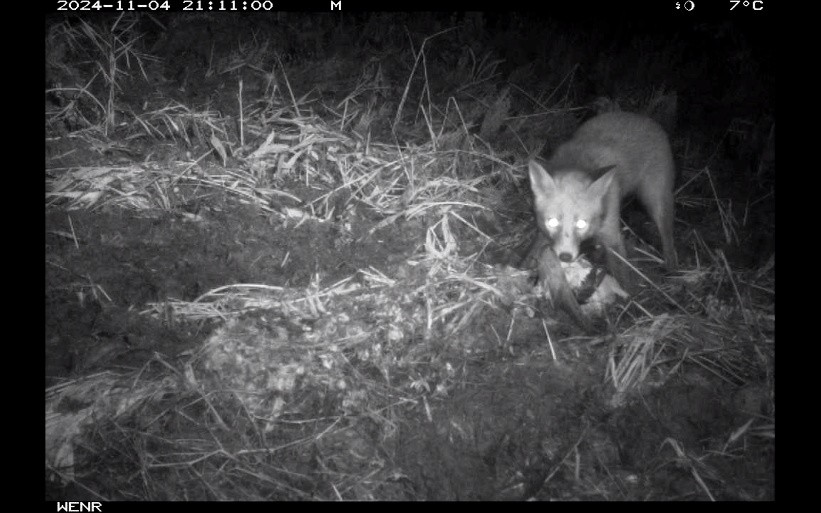
In Europe, the virus has been found most often in mammals, including carnivores and scavengers. In the wild, wild carnivores and scavengers are exposed to the virus, including when they eat the carcasses of infected birds, as observed last season in Strong1H’s camera trap footage (see photo).
Some animals die from the infection, and we sometimes find the virus in these animals. Animals that were infected and survived, but died from other causes, may have antibodies. Together, these provide information about the risk of infection.
Animals can be reported via our online form. Not only animals found dead and euthanized, but also shot animals and roadkill can be submitted to the Dutch Wildlife Health Centre (DWHC) for investigation. In the case of road accident victims, it is important that the head and chest are not visibly injured, as the brain and lungs in particular are examined.
Even if it is not possible to collect the animal for further research, we appreciate your report. You can include any observations in the comments field. If you indicate that you would like to submit the animal for examination, we will contact you. It is important to safely and hygienically double-wrap the animal, as stated in the NVWA’s guidelines for disposing of dead wild mammals. Note: If you observe neurologically abnormal behavior in a carnivorous/scavenging mammal before death, the NVWA asks that you contact them (090 00388).
More information about Strong1H can be found on the RIVM website.