

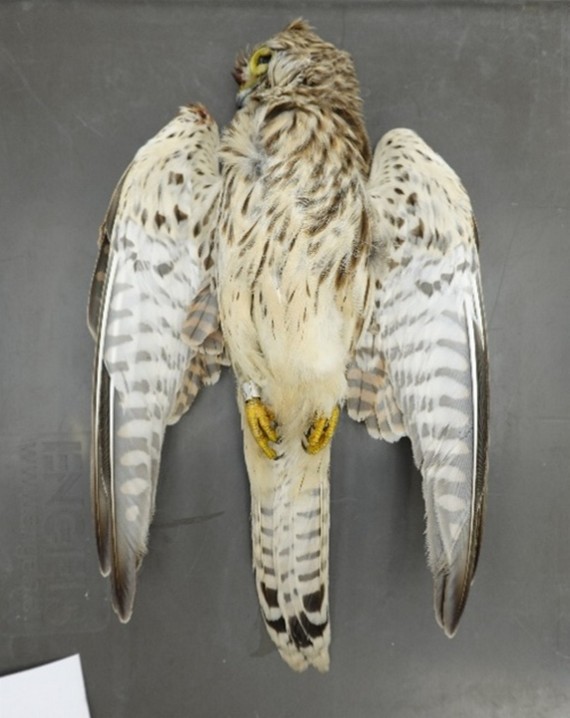
The Common Kestrel (Falco tinnunculus) and Peregrine Falcon (Falco peregrinus) have been the DWHC focal bird species of 2025. The aim was to be able to examine more of these species to determine their cause of death and underlying disease. Common Kestrels and Peregrine Falcons are birds of prey that sit high in the food chain. By consuming prey, they can also become infected with certain diseases themselves. This makes them an indicator of the diseases present in a region. In 2025, we were able to retrieve a total of 3 Common Kestrels and 2 Peregrine Falcons for full pathological examination. This number is limited by the current bird flu outbreak. In addition, 7 Common Kestrels and 1 Peregrine Falcon were sent directly to WBVR for bird flu testing.
Research at DWHC
Trauma was the cause of death for nearly all the focal birds examined at the DWHC (4 of 5). These were 3 Common Kestrels and 1 Peregrine Falcon. These birds had internal bleeding and some also had broken ribs.
There was one Peregrine Falcon with a cause of death different from trauma. This bird died from a bird flu infection. The bird had a severely inflamed spleen, a mild brain infection, and fluid in the lungs.
Bird flu
All birds were tested for bird flu, including those examined at the DWHC. In total, 10 Common Kestrels and 3 Peregrine Falcons were tested for avian influenza. Four and two birds respectively tested positive. Follow the updates on bird flu tests in 2025 per month here.
The Common Kestrel
Bird flu was a major cause of death for the Common Kestrel. Almost half of the examined birds tested positive for the virus (4/10). Birds of prey are generally more susceptible to infection because they often hunt prey that may be infected with bird flu. For the Common Kestrel, however, this is a new and relevant finding, because this species mainly eats Common Voles. Rodents, such as the Common Vole, are not known carriers of bird flu. Therefore, it appears Common Kestrels become infected by eating infected birds. This also suggests that Common Kestrels are more dependent on avian prey than previously thought.
The Peregrine Falcon
In 2025, bird flu was again a major cause of death for the Peregrine Falcon. Of the three examined birds, two tested positive for bird flu. It was already known that Peregrine Falcons are susceptible to severe illness and even death following a bird flu infection (see Nature Today article).
A new study forecasting Peregrine Falcons in the Netherlands shows that bird flu can have large and long-lasting demographic effects on the population. This means it may take about ten years for the number of breeding Peregrine Falcons to recover to nearly the same level as before the outbreak. Ultimately, their number is likely to stabilize at about 21% of the original size. (Badia et al., 2025)
Reference
Badia-Boher, J. A., Schaub, M., Mollet, M., van Geneijgen, P., van der Jeugd, H. P., Caliendo, V., & Kéry, M. (2025). Evaluating the demographic impacts of the highly pathogenic avian influenza panzootic. Journal of Applied Ecology, 00, e70234. https://doi.org/10.1111/1365-2664.70234