

In early July 2026, a wild boar with skin lesions was seen in the province of Gelderland. The animal was examined at the DWHC after their death. The adult male wild boar was in good condition with normal musculature and fat reserves. The examination revealed that the boar was suffering from scabies, caused by the scabies mite (Sarcoptes scabiei, see figure). The animal’s skin was severely inflamed due to the scabies mite, along with a secondary bacterial infection.
Sabies is highly contagious and spreads primarily through direct contact between animals. Infected animals often have thickened skin with scabs, hair loss, and severe itching. The scabies mite is species-specific; while the wild boar mite can cause temporary itchy skin complaints in humans, it cannot survive here for extended periods. Indirect transmission via the environment is possible but rare.
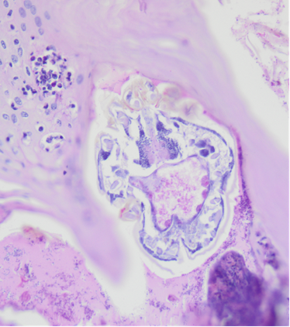
Figure: Microscopic image of the scabies mite in the skin of a wild boar | Photo: DWHC
Scabies in wild animals in the Netherlands
The DWHC has previously found the presence of the scabies mite in the Netherlands. Between 2014 and 2018, Sarcoptes scabiei (vulpes) was found annually in foxes in a specific area in the province of Limburg. In 2018, the scabies mite was detected in a wild boar in the province of Gelderland; in this case, it concerned Sarcoptes scabiei (suis). A year later, Caparinia tripilis was found in a hedgehog in the province of Gelderland. This is a different species of scabies mite and is specifically known as a mite that is found in hedgehogs.
From 2020 through 2025, the scabies mite has not been detected in animals examined by the DWHC. The finding in this wild boar in the province of Gelderland is therefore the first confirmation of mange mites in a wild animal since 2019.