

Rat and mouse poison ends up on a large scale in animal species for which these substances are not intended, such as foxes, martens, hedgehogs, birds of prey, and owls. Since the stricter policy in 2023, no lasting decrease in this secondary poisoning has been observed. This is evident from research into secondary poisoning from rat and mouse poison (formally called rodenticides) by the Toxicology department of WUR, the Dutch Wildlife Health Centre (DWHC), and CLM Onderzoek en Advies.
Rat and mouse poison may only be used by professional pest controllers after non-chemical measures (for example, placing snap traps) have been implemented within integrated pest management (IPM) and this has proven insufficient to control the infestation. Since 2023, regulations apply to use in buildings, pest controllers must be trained, and their company must possess a certificate. The aim of the regulations is, among other things, to prevent resistance and to reduce poisoning of humans and animals. To determine whether these regulations against secondary poisoning are effective, the Ministry of Infrastructure and Water Management has commissioned new research, supplementing an earlier study from 2019.
Rat and mouse poison inhibits blood clotting and thus leads to internal bleeding, also in non-target species. Non-target species such as snails, songbirds, field mice, shrews, and weasels can ingest poison by eating from bait boxes containing the poison. Predators also ingest the poison if they eat rats, mice, or these non-target species. This constitutes secondary poisoning (see infographic 1). This causes animal suffering, and the internal bleeding increases the risk of premature death.
In this study, rat and mouse poison was found in all foxes (n=13) and virtually all stone martens (n=218). One or more of these substances were found in 84% of the hedgehogs (n=86), and in 58 to 100% of the birds of prey and owls (see infographic 1). Compared to the 2019 study, the rate of secondary poisoning has not decreased. Moreover, concentrations did not decline permanently between 2020-2022 and 2024-2025.
Consequently, the stricter regulations for IPM have not led to a reduction in secondary poisoning of the studied species. This applies to both rural and urban areas. To reduce secondary poisoning, better implementation and/or tightening of policy is necessary. In addition, continuing the monitoring is essential to identify future trends in exposure.
For this study, the researchers used samples from animals submitted for pathological examination. Collaboration also took place with hedgehog rescue centers, and stone martens were received via meadow bird management. No animals were killed for this study.
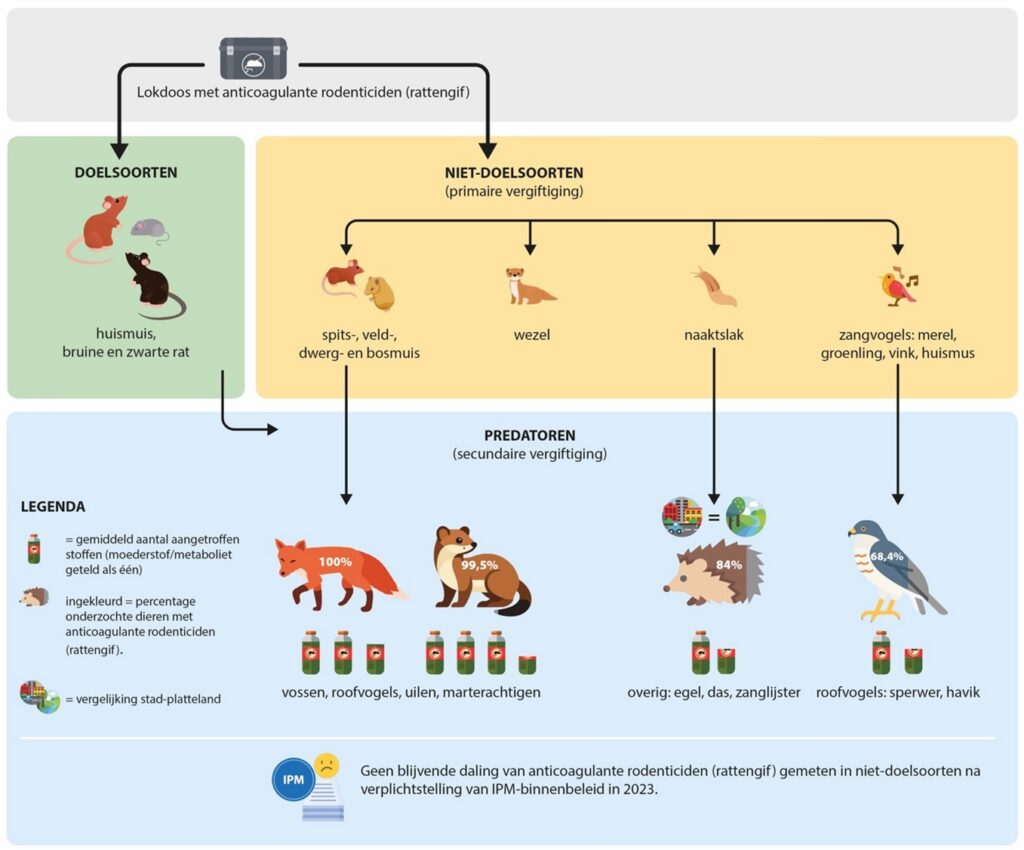
Infographic 1. Summary of the results of the study on secondary poisoning from rodenticides visualized (source: CLM).
Questions? Contact the project leader here.