

For many, the summer holidays have started. Although we take a little more time for relaxation during this period, and reports of bird mortality are often somewhat quieter, please remain alert and report (unusual) bird mortality.
In May and June, it became clear that the 2025/26 bird flu outbreak was quieting down. The last infections on poultry farms occurred around May 14 near Biddinghuizen and around May 23 near Marrum. At the same time, the number of cases of bird flu among wild birds showed a downward trend, both in the Netherlands and in surrounding countries. The nationwide obligation to keep poultry indoors and shielded was partially lifted on April 21 and fully lifted on June 11.
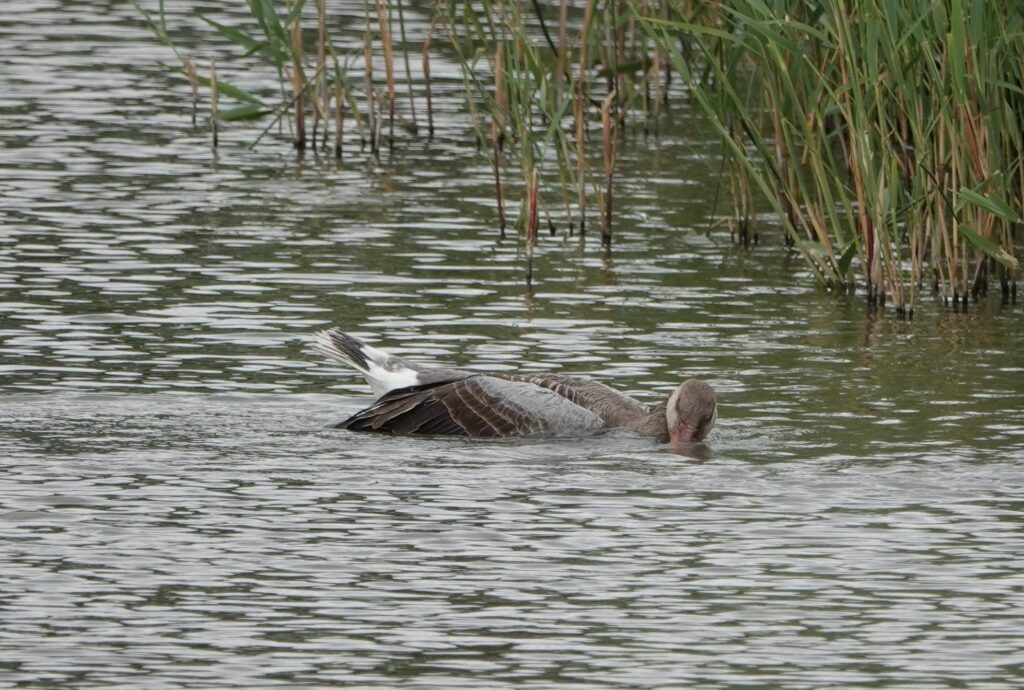
A Greylag Goose showing signs of avian influenza infection. Photo: Sovon
Bird flu still present
Although all of this is good news, we know that the highly pathogenic H5N1 virus has not completely disappeared from the Netherlands. In May, eighteen dead wild birds were sent by the Dutch Wildlife Health Centre (DWHC) to Wageningen Bioveterinary Research (WBVR) to be tested for bird flu. Half of them tested positive. These involved a Mute Swan, six Greylag Geese, an Avocet, and a Common Tern. Of the 52 dead wild birds from June for which results are now available, twelve were positive (eleven Greylag Geese and a Great Crested Grebe). Monthly overviews of the test results are maintained on our website.
Based on these figures, it appears that things have remained quiet in the various colonies of gulls and terns, and that we mainly need to take into account the circulation of the virus among waterfowl (particularly geese). Vigilance during the summer months is therefore most desirable in areas with high densities of these species. For a quick overview of where these locations are situated, we refer to the recently published report of Sovon ‘Distribution of bird species associated with avian influenza in the Netherlands’.
Usutu virus, botulism, and other causes of death
In addition to avian influenza, there are numerous other causes that can lead to increased bird mortality. For instance, every year in May-June, we see many newly fledged young birds die in accidents due to collisions with cars and windows, among other things. The reports of Great Spotted Woodpeckers and Jackdaws illustrate this well (Figures 1 and 2).
Another cause of increased mortality is botulism. This is a well-known disease that causes mortality among ducks, particularly during the summer months, whereas in recent years, the Usutu virus has mainly affected songbirds. The latest issue of Sovon News reports that Blackbird breeding numbers dropped in 2025 to the lowest level in the entire series since 1990 (index value 74) following a new Usutu outbreak in the second half of 2024, but also that Usutu appears to be an important explanatory factor for the population trend of the Wren.
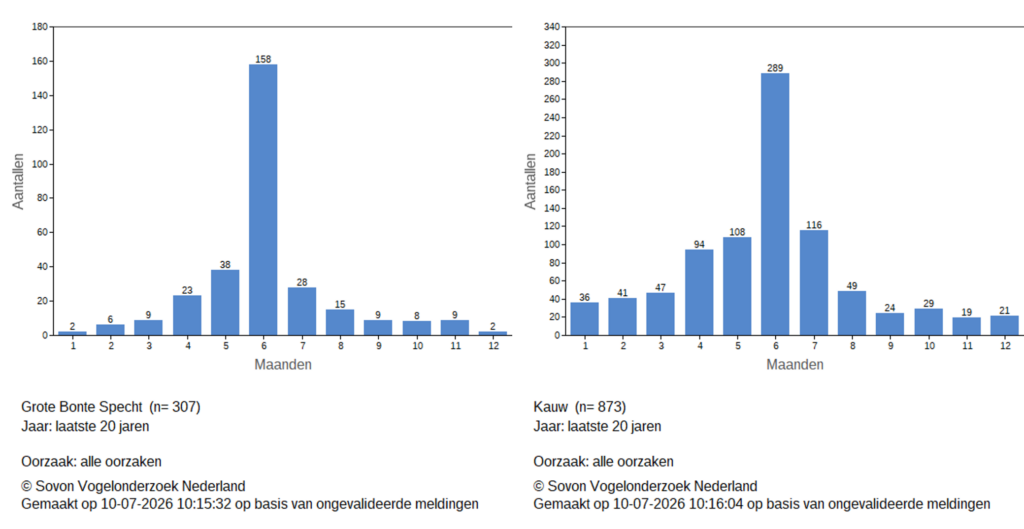
Figures 1 and 2. Numbers of dead Great Spotted Woodpeckers and Jackdaws reported to Sovon over the past 20 years.
Found a dead bird?
Being alert to bird mortality is important and yields valuable knowledge and timely signals about what is happening in nature. We therefore greatly appreciate every report. Generally, you might be more inclined to report a rare bird, but remember that common species matter just as much. And reports from all over the country are valuable.
Do you want to make a report, and is your find potentially suitable for investigation into the cause of death? Then please contact the Dutch Wildlife Health Centre by filling out the submission form.
Do you want to pay more systematic attention to bird mortality during bird counts? Then join the LiveAtlas project by Sovon.
Missed the podcast? Listen to it now!
On the websites of the DWHC and Sovon, you can find a lot of information about how you can contribute to research into avian influenza and other bird diseases. Would you like to hear some more background on this important work? Then listen to our podcast, in which Wim van Boekel explains how bird counts in the field are conducted and Judith van den Brand explains the research at the DWHC (Dutch).