

Between March 2024 and April 2025, hunters, wildlife managers, and roadkill coordinators were asked to send blood samples from roe deer to the Dutch Wildlife Health Centre (DWHC). The samples were examined by the RIVM for the presence of antibodies against tick-borne encephalitis virus (TBEV). The results were used to create a risk map for TBEV in the Netherlands. TBEV is a virus that can be transmitted via tick bites and can cause severe encephalitis in some cases. The virus was only first found in the Netherlands in 2015, but has since been found in multiple areas.
Roe deer can become infected with the virus via tick bites. Roe deer themselves rarely become ill. Due to the relatively small habitat of the roe deer, they can serve as an “indicator species”: antibodies in roe deer can indicate that the virus is present in the area.
The study – TBEV risk map of the Netherlands
To predict in which areas the virus may potentially occur, even if no cases of the disease have yet been discovered there, an extensive risk map of the Netherlands has been generated. Instead of only looking at known infections in humans or ticks, this map visualizes potential risk areas. In these areas, tick monitoring can be carried out to confirm the presence of the virus. Additionally, the risk map serves as a tool for alertness and prevention.
To develop the risk map, information on the environment and the occurrence of various animal species was combined with data on habitat use from the literature. This was used to create a model that calculates, per square kilometer, how suitable an area is for the occurrence of the TBE-virus. To test whether the model accurately calculates the actual occurrence of the virus, the prediction was compared with results from the roe deer blood sample study of 2024-2025.
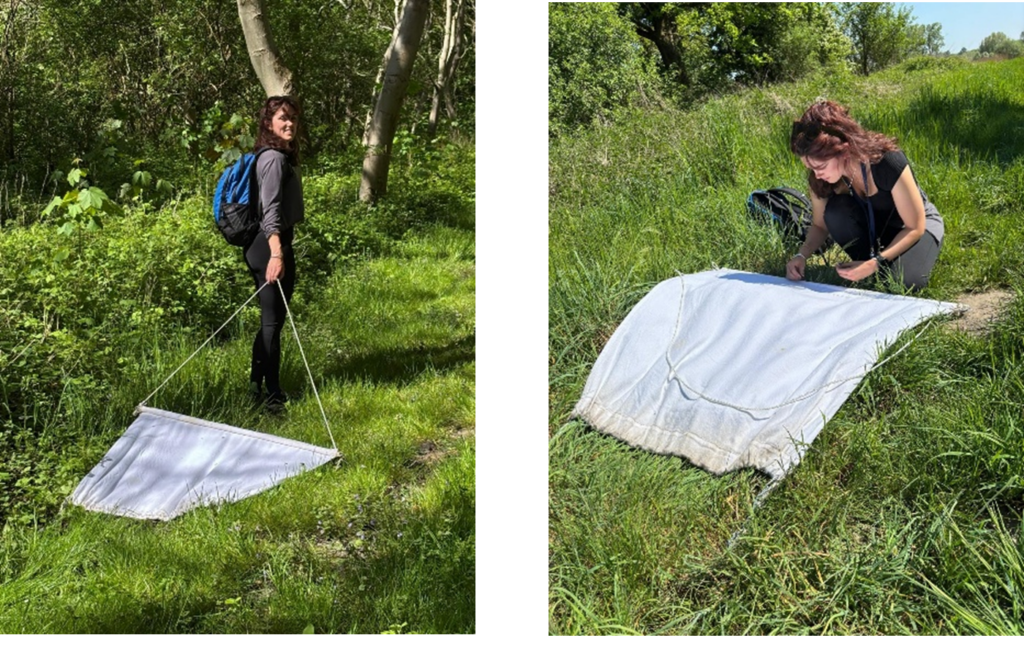
Tick monitoring: ticks are collected with dragging a cloth over the ground| photo: DWHC
Large parts of the Netherlands suitable
This research shows that large parts of the Netherlands are suitable for the occurrence of TBEV. Areas with high numbers of both ticks and small rodents constitute potential risk areas. Ticks were subsequently collected in these areas to investigate whether they were infected with the virus.
In doing so, the virus was detected in regions where it was previously unknown. For instance, the virus was confirmed in a tick in the province of Zeeland, an area not previously known as a risk area. Indications of the virus’s presence have now been found in 18 of the 25 Dutch GGD regions.
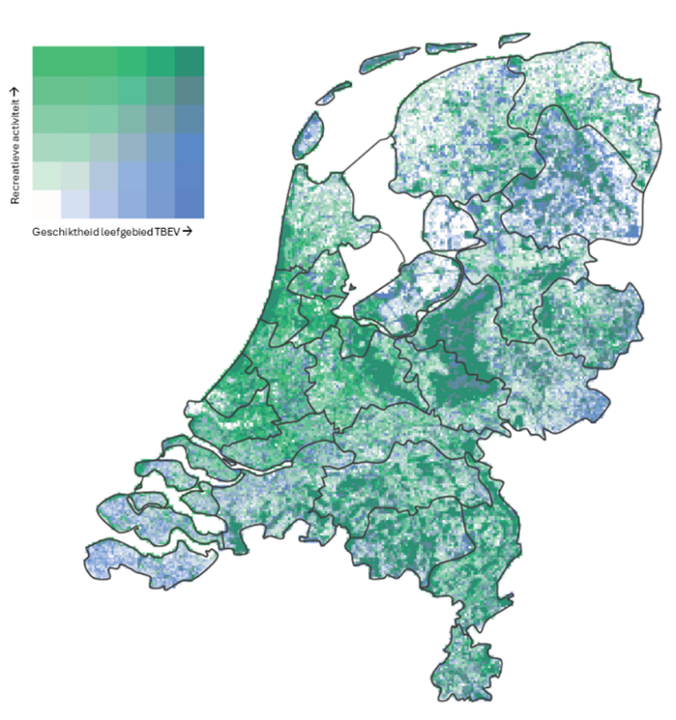
Figure: Map of the Netherlands showing the overlap between recreational activity and habitat suitability for TBEV. Light green areas have higher recreational activity and lower TBEV habitat suitability. Blue areas have higher TBEV habitat suitability and lower recreational activity. Dark green areas have both high recreational activity and high TBEV habitat suitability. “ | Source: Wijburg et al. (2026) in Eurosurveillance. Licensed under CC BY 4.0.
What does this mean for visitors of nature reserves?
For hikers, campers, and people who frequently visit nature, the risk of infection remains low. Nevertheless, based on this research, it can be concluded that the virus is present in more places than previously thought.
Especially in forest and nature areas with many ticks, it therefore remains important to take measures against tick bites, such as:
- wearing protective clothing,
- checking yourself for ticks after a walk,
- removing ticks as soon as possible.
We would like to thank all contributors for their time and effort. Your contribution is essential for this type of research.
Source
Wijburg Sara R, Rockx-Brouwer Dedeke, Herbert Megan K, Rijks Jolianne M, Lesiczka Paulina M, Maas Miriam, Gröne Andrea, Hakze-van der Honing Renate W, Holding Maya, Esser Helen J, Sprong Hein, Fischer Egil AJ. Targeted monitoring informed by mapping the ongoing spread of tick-borne encephalitis virus, the Netherlands. Euro Surveill. 2026;31(20):pii=2500767. https://doi.org/10.2807/1560-7917.ES.2026.31.20.2500767. Licensed under CC BY 4.0.