

In April 2026, several dead and weakened hares (Lepus europaeus) were found in two areas in the provinces of Friesland and Overijssel. The animals were often emaciated, showed little flight behavior, and became weakened and apathetic in the final stages. A dead hare was collected from both areas for pathological examination at the DWHC.
These were two adult male hares with severe acute inflammation of the lungs, liver, and spleen, among other organs, with tissue necrosis. In addition, a mild infection with Coccidia spp. was detected in the intestines of one hare, and an infection with the intestinal parasite Trichostrongylus retortaeformis in the other. Tularemia (hare fever) was confirmed in both animals using PCR testing.
Tularemia in wild animals
Tularemia is caused by the Francisella bacterium and can cause severe illness and mortality. Many different animal species can be infected with this bacterium: mammals, birds, reptiles, amphibians, insects, and arachnids (ticks). However, there are differences in infection rates and the effect on the animal species. Lagomorphs and rodents, in particular, are susceptible to infection by the bacterium, and some species may serve as reservoirs. See the figure for the distribution map of wild animals that tested positive for tularemia from 2013 through mid-May 2026.
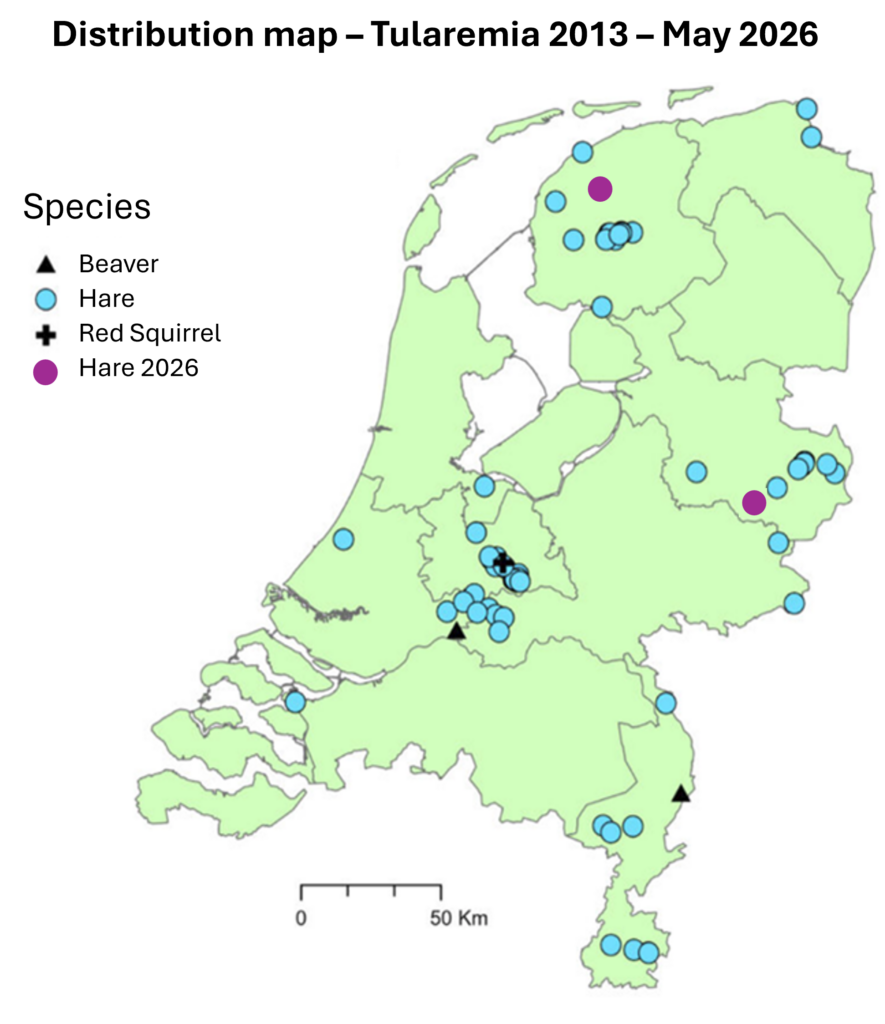
Hares suspected of having tularemia are noticeably weak and apathetic. They have a swaying gait and have lost their natural shyness. Note: these symptoms can also indicate another disease. Because tularemia can be transmitted to humans, it is advised not to touch dead or sick hares with bare hands.
Honden en tularemie
Pets such as (hunting) dogs can also become infected with tularemia if they pick up or gnaw on dead hares. Dogs are much less susceptible to the rabbit plague bacterium. If they become infected, the symptoms are usually mild. Symptoms in dogs include a reduced appetite for a few days, possibly a fever, and reduced fitness. A dead hare may also carry another disease to which a dog is susceptible. Therefore, the advice is not to feed hare meat to the dog.
If a dog shows symptoms after contact with a dead, sick hare, contact the veterinarian. A veterinarian can have the blood tested if necessary.