

The DWHC, together with Wageningen Bioveterinary Research (WBVR), has conducted research into the reliability of the Clungene rapid test for detecting avian influenza in dead wild birds. The results of the rapid test were compared with standard PCR diagnostics, which is currently used for reliable confirmation of avian influenza infections.
The research shows that the rapid test has limited reliability in wild birds. Although positive results often prove to be correct, the test misses a significant proportion of actually infected birds. The diagnostic sensitivity of the rapid test compared to PCR is 33% for cloacal swabs and 38% for tracheal swabs. This means that for >60-70% of PCR-positive dead wild birds, the diagnosis from a rapid test for detecting avian influenza does not correspond with the results of the PCR for the virus. This means that infected animals may falsely test negative for avian influenza.
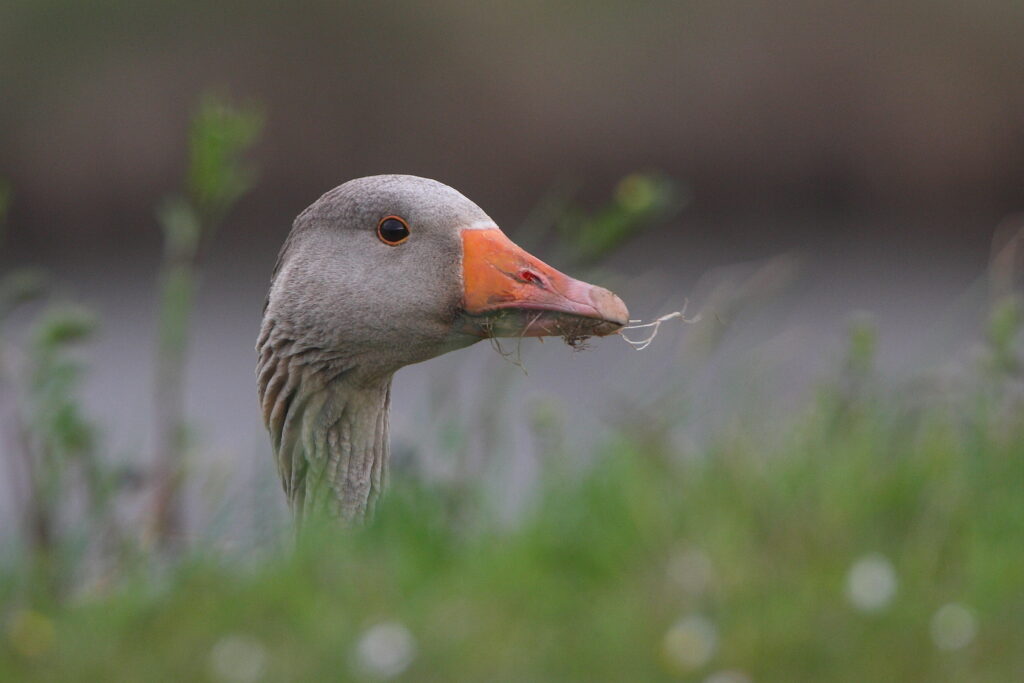
Greylag goose. Picture by: Dick Pasman
There are several possible causes for this lower reliability. It is possible that virus concentrations in dead wild birds are lower than in experimentally infected poultry: the duration and level of virus shedding may depend on the virus strain and the bird species. Furthermore, conditions can have an influence (number of days dead, ambient temperature, temperature during storage/transport).
Based on the research results, it is advised not to use the rapid test on wild birds. Rapid tests may potentially play a supplementary role in the field, but are currently insufficiently suitable as a standalone diagnostic method.